









In April 2023, Gaurav Maurya, a farmer from Sonbhadra district in Uttar Pradesh, tried growing grafted brinjal on just 0.125 hectares of land. By March 2024, he had harvested around 112 quintals of brinjal and earned a net profit of ₹2.27 lakh. The results encouraged him to take the technique beyond his own farm and start producing grafted vegetable seedlings for other farmers. According to the official website of Indian Council of Agricultural Research (ICAR), Maurya sold nearly 75,000 grafted tomato and brinjal seedlings in the following year, earning another ₹3.37 lakh in net profit. According to a newer report by 30Stades, he subsequently developed the venture into a nursery business that supplies grafted plants to farmers within and beyond Uttar Pradesh.
How a small brinjal trial led to a new business
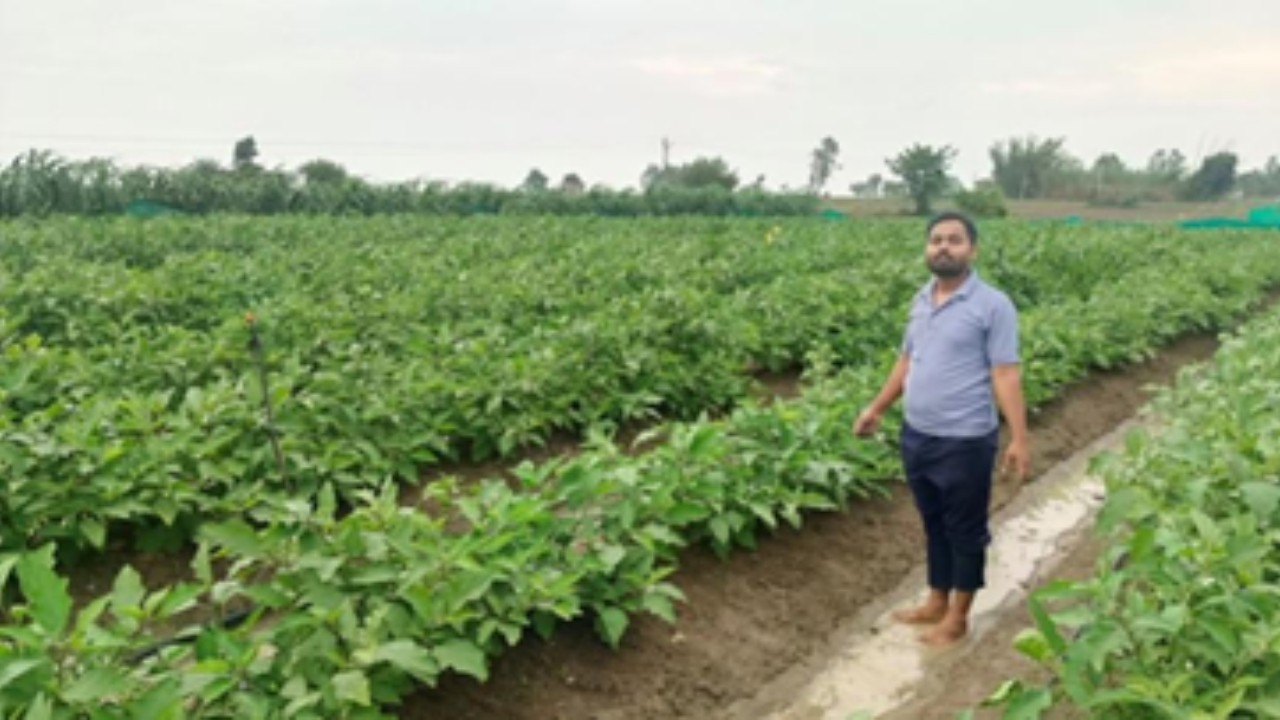
Photo credit: ICAR
Maurya began his commercial trial with hybrid brinjal seedlings grafted onto ‘Solanum torvum,’ a rootstock used in vegetable cultivation. According to ICAR, harvesting began in the first week of July 2023, when wholesale market prices averaged ₹42 per kg. The crop continued producing fruit until March 2024, yielding approximately 112 quintals. As reported by ICAR, he had a net profit of ₹2.27 lakh from the crop. The institute noted that grafting helped address problems such as bacterial wilt and root-knot nematodes, which can affect vegetable production.Grafting involves joining two plants so that they grow as one. The upper portion, called the scion, is selected for its desired fruit and variety characteristics, while the rootstock provides the root system and may offer resistance to certain diseases or environmental stresses. The results of his trial prompted Maurya to consider whether other farmers could benefit from the same technique. Instead of using grafted plants only on his own land, he began producing seedlings for sale. In the subsequent year, he produced and sold nearly 75,000 grafted tomato and brinjal seedlings, earning a net profit of ₹3.37 lakh, according to ICAR. He used social media to reach farmers in Sonbhadra, Chandauli, Mirzapur, Prayagraj, Ghazipur, Gorakhpur and Azamgarh.
From agriculture graduate to nursery entrepreneur
Maurya completed a BSc in Agriculture at TD College in Jaunpur in 2021, according to 30Stades. After graduation, he joined his family’s farming operations while continuing to explore opportunities in agriculture. In 2023, he opened an agricultural input shop in Sonbhadra, selling seeds, manure and fertilisers. He later expanded the range to include biofertilisers and pest traps. The business helped him understand the challenges farmers faced and build relationships with potential customers. Meanwhile, he continued learning about vegetable grafting through online resources and scientific research, experimenting with the technique on his family farm.
How his nursery produces grafted plants
Maurya’s nursery supplies grafted brinjal, tomato and chilli plants. According to 30Stades, the process takes around 50-60 days from sowing to dispatch. After grafting, the young plants are placed in a healing chamber under controlled conditions. The environment uses low light and high humidity for about seven days, allowing the joined sections to heal. According to 30Stades, Maurya estimates that producing a seedling costs ₹8-10, while the selling price ranges from ₹12 to ₹13, depending on the variety. He reports a survival rate of around 90%. Farmers place orders according to the varieties they need, allowing him to plan nursery production around demand.
Reported turnover reaches ₹60 lakh
As reported by 30Stades, Maurya sold around four lakh plants in the previous year, generating approximately ₹60 lakh in turnover and ₹16 lakh in profit. It also reports that he expects to sell around six lakh plants in 2026. Maurya also grows vegetables on four acres, including cauliflower, coriander, green chilli, grafted brinjal and papaya. Maurya aims to increase annual production to 20 lakh plants by 2027.