











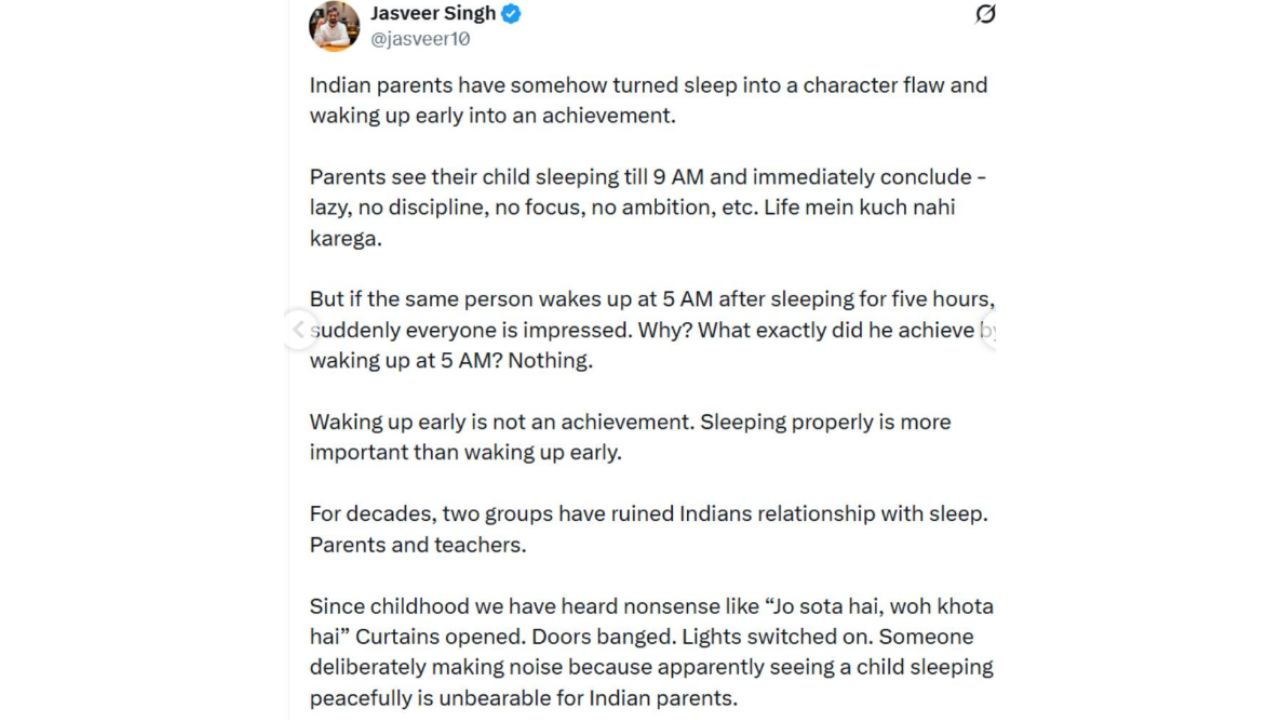
For generations, waking up at dawn has been treated in many Indian homes as a sign of discipline, while sleeping until 8 or 9am can invite accusations of laziness. A recent post by Jasveer Singh, co-founder and CEO of Knot Dating, has challenged that familiar idea, arguing that getting enough sleep should matter more than simply being out of bed at an impressive hour. His post, shared on X on August 31, has since sparked an online debate. “Indian parents have somehow turned sleep into a character flaw and waking up early into an achievement,” Singh wrote. His question was simple: if someone sleeps until 9am, why are they immediately labelled lazy or unambitious, while someone who wakes at 5am after just five hours of sleep is praised for being disciplined?
Is 5am really better than 9am?
Not necessarily. Sleep experts generally focus far more on how much sleep a person gets and its quality and regularity than on whether they wake at 5am or 9am. According to a review published in Applied Physiology, Nutrition, and Metabolism and indexed on PubMed, 7–8 hours of sleep per day was most favorably associated with health outcomes among adults. The review analyzed 36 systematic reviews involving more than 4.4 million participants from 30 countries.That means waking at 5am isn’t inherently an achievement if it comes at the cost of adequate sleep. Someone who goes to bed at 9pm and wakes at 5am has had eight hours of sleep. Someone who goes to bed at 1am and forces themselves up at 5am has had four. The clock says both people are “early risers”. Their bodies would disagree.
The science behind the “body clock”
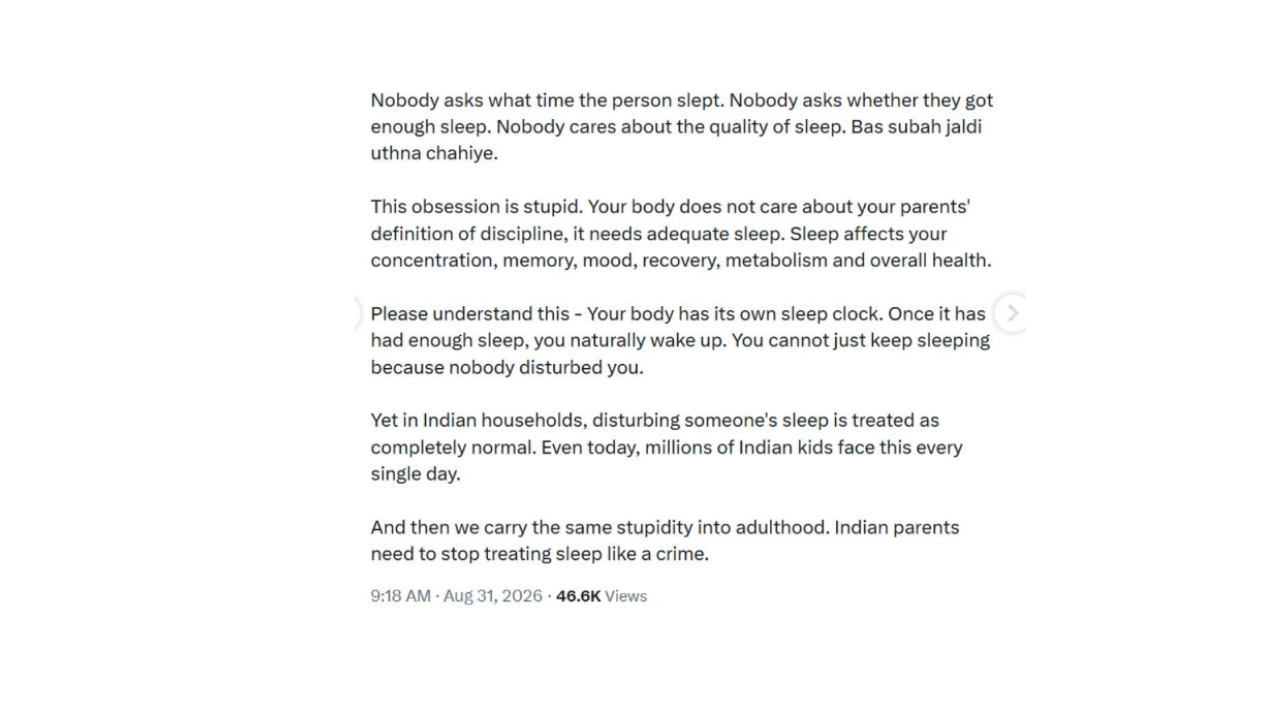
Singh also argued that the body has its own sleep clock and there is some science behind that idea, although it is more complicated than simply saying “your body wakes up once it has had enough sleep.”
Our sleep-wake cycle is influenced by the circadian rhythm, an internal biological clock that helps regulate when we feel sleepy and alert. That rhythm differs between people and can also change with age. Teenagers, for instance, naturally tend to shift towards later bedtimes and wake times during puberty. The American Academy of Pediatrics has noted that adolescents can have difficulty falling asleep early and that early school timings can contribute to chronic sleep deprivation.
Research has also found that delaying school start times can increase sleep duration and reduce daytime sleepiness among students. So a teenager struggling to wake up at 6am isn’t necessarily demonstrating poor discipline. They may simply be fighting biology, particularly if they were not allowed enough time to sleep.
But sleeping late isn’t automatically healthy either
This is where the viral argument needs some nuance. Sleeping until 9am isn’t automatically healthy, just as waking at 5am isn’t automatically healthy. If someone regularly sleeps for nine or 10 hours because they are catching up on chronic sleep deprivation, that is different from someone who gets adequate sleep but simply has a later schedule.Similarly, regularly sleeping excessively, struggling to wake despite adequate sleep, or feeling exhausted during the day can sometimes signal an underlying sleep or health problem and should not simply be dismissed as having a “different body clock.”
Why do Indian parents care so much about early mornings?
That’s the cultural heart of Singh’s argument. In his post, he recalled the familiar childhood experience of curtains being opened, lights switched on and doors being banged because a child was still sleeping. He questioned why parents often ask what time the child woke up, rather than what time they went to bed or how much sleep they actually got. The idea that early rising equals ambition is deeply embedded in many households. But the science suggests a more useful question:Not “Did you wake up early?” but “Did you get enough good-quality sleep?”Waking up at dawn can certainly work for someone whose schedule and biology suit it. But there is nothing inherently virtuous about a 5am alarm and nothing inherently wrong with a 9am wake-up. Discipline should perhaps be measured by what you do with your day, not by how dramatically you begin it.